Thursday, November 3, 2011

Two steps forward, a long walk back

Saturday I intended to go to the lake, but got caught up formatting the endless stream of ride results and standings for the November PNER newsletter. I looked up from InDesign at 3:30 and realized I'd better get it in gear if I wanted to ride in the daylight.

We warmed up with bareback arena exercises, then I went and got the saddle. Oh boy, did my stirrups feel short after all that bareback work! I took them down a notch, and we started out to ride the perimeter of the pasture, which encompasses a mix of steep and rolling hills, a bit of gravel, and a slightly obstructed view of neighbors gardening, mowing and just generally being as spook-inducing as possible. 

The circle in the ground where the round pen used to be is still pretty visible. It will probably be visible to archaeologists 1,000 years from now, with or without satellite imaging. I thought it would be a good challenge for Blue to be trotting the pasture at a good clip, then to take that circle like a volte and continue back to the perimeter. It turned out to be a very good exercise, as he tried to run out of the circle about ten times. We'd start in a relaxed trot, but as he reached the far end of the circle (closest to the trailer and hitching rail), he'd speed up, put his nose in the air, and drift outwards with no regard for my seat or legs.

He's an opinionated beast, and I suppose his opinion was that it was time to quit. He was wrong of course. By the second attempt, I was ready for him, with a more aggressive seat and leg. No dice. He fell out of the circle in a stiff, fast, hollow, angry, head-tossing trot. I one-reined him to my knee and gave him a taste of the spurs (both actions being punishment and not aids—yes, he can tell the difference) until he was turned back into the circle. Then I proceeded as if nothing had happened. Five strides later, back in the same spot, he did the same thing again. So I did the same thing again. 

We went around like this more times than I'd like to admit. This kind of testing behavior does not reflect well on Blue. Trying the same thing over and over and expecting a different result doesn't say much for his intelligence, either.

We got through it, though, and returned to the perimeter. When we hit the gate, I turned him out of the pasture and headed for the trees.

The nice thing about riding in this kind of tree farm is that everything is in neat rows, providing a nice visual cue for where to go. So we did a 300-yard straightaway, then cut between two trees and did the same thing in the other direction. Lather, rinse, repeat. When that got boring, I started slaloming the trees two-by-two. All of this was going very well. Blue was light and interested. Then The Bad Thing happened. Physics conspired against me.

I reached up to push a long, leafy branch out the way, as I had a hundred times before. I released it, and, unlike the hundreds of times before, it came aback at just the right speed and angle to smack Blue right in the butt. He gave an almighty kick. I landed up on his neck with him still pitching, and I had a decision to make. I wasn't having much luck with stopping him or getting back down into the saddle, so I decided to slide off to the side.

That worked out fine except that I let go of the reins. So Blue energetically trotted toward home without me. I keep meaning to teach him to come when he's called. Times like this, I wish I'd done more of that training with him when he was confined to The Pen.
 
"BooooooBoooooo!" I called in my sweetest singsong. "Come here, Boooo!"
He stopped a couple football fields away, flicked an ear at me, took a moment to consider, then turned back toward home at nice, smart trot. He looked much too proud of himself.

Luckily there was an alfalfa field between me and home, so I didn't have to walk the entire way. We got back to the driveway, did the perimeter again, did the circle again, and called it good. It was getting a bit dim out anyway.

Wednesday, November 2, 2011

Lopsided, and some thoughts on saddles

Work gets out early on Fridays, so there was still enough daylight to do some riding. I went in with a plan to work on my own balance. Something I never would have done with the unpredictable Otto: bareback arena work.

Obviously I started at the walk. I haven't ridden bareback a whole lot, and it shows in my complete lack of ability to sit a horse. I remember when I got Gazab, way back in Nebraska, my dad rode him bareback around the pasture at a canter. I wouldn't even canter in a saddle at that stage. 

I still can't canter bareback, but after a lot of initial wobbling, I got to be pretty comfortable in the trot on Friday. I felt a real sense of teamwork with Blue. It seemed like he was working just as hard to stay under me as I was working to stay on top of him. 

I have been contemplating getting some sort of deep-seat "Englishy" saddle as an alternative to the Specialized. I feel like swapping periodically might be better for Blue's back and my riding. Part of this contemplation has been looking at Blue's back. Sitting on it bare gave me a better sense of how he's using it now, and what the overall silhouette is. The next step was to stand on something tall behind him and look at symmetry (or the complete lack thereof).
 
Sigh.
 

My poor track record of staying in the saddle attracts me to something like this: 
 
 
Short of someone turning the horse upside-down and shaking him, I'd pretty much be glued in. The trouble with poleys (i.e., those leg-holder-inners on the front of the saddle) in endurance is pretty obvious: You might end up with bruised legs from posting into them for hours at a time. I also have heard from many people that the fit on Aussie saddles can be iffy at best, and that the good ones cost a fortune. Plus, I really love the dressage-style rigging on my Specialized. I'd hate to go back to a bulky western knot or a fat English buckle under my leg.
 
So what are my other options?
 
 
It seemed like a good idea at the time.
 
I flirted with the treeless thing for a while with Otto. I bought a very pretty used Torsion to use as a backup saddle. It was so light and cushy… like a leather easy-chair. Unfortunately, it was amazingly slick, and the lack of twist made it feel like I was a living in a Thelwell comic. 
 
Needless to say, this is not a particularly secure way to sit, especially for Otto's "sideways teleportation" style of movement. 

They make treeless, flex-tree and semi-treed saddles that are meant for a more secure ride.

Like this one, for instance.

I'm intrigued by the Kuda saddle above because it looks like it might offer a bit more security and grip. Maybe even a teeny bit of twist and lift so I don't feel like I'm sitting directly on Blue's spine. On the other hand, they aren't exactly cheap from the dealer, and they are new enough that the secondhand market is almost nonexistent. It would be an expensive experiment.

The other saddles I came across seem almost too good to be true. 
 
Kind of a dressage/endurance hybrid.

This one doubles as a mattress.

That seat is completely impractical for my needs, but look how pretty!

Imagine, no fenders or leathers under your leg, plus a front grip. And again, all that padding!

This one reminds me of my RL Watson, a saddle that made my butt very happy.
 

All of the saddle styles above come from the same maker, Sycamore Creek/CTK. And they have dozens more styles. I always check horsetackreview.com when I'm thinking about a piece of equipment or clothing. Sycamore Creek has no ratings lower than 4 out of 5. That's pretty much unheard of, even for some of the most upmarket commercial saddles. The reviews rave about the customer service, great price-to-quality ratio, super comfy construction… Did I mention the prices? I think the most expensive of the saddles above comes in under $700. You read that right.
 
The hardest part about Sycamore Creek would be choosing a style. I actually emailed Tony, the U.S. distributor, and asked for his opinion on my situation. I told him the four models that seemed closest to what I was looking for. He said any one of them would probably work for Blue's back conformation, so the choice was more about what worked for me as a rider. They will customize the saddle to fit us both.

What would fit me, dear reader, is a leather saddle with some grip, at least a 5-inch-deep seat, a high cantle, dressage rigging, leathers instead of fenders, and enough rings and straps to contain all my gear. I also need it to cost less than $1000, last forever, and fit my horse perfectly.

Is that so much to ask?! :)

Tuesday, November 1, 2011

They call it work for a reason

Arena work isn't exactly my favorite thing in the world. I appreciate the safety of the relatively controlled environment, but it also gets boring. 

Heather was supposed to have a lesson on Sunday, so we thought the prudent choice would be to take the horses to the arena on Wednesday evening and make sure they could handle it. Both have been in indoor arenas before, but this one is a 3/4 indoor with potentially scary mirrors and barn cats trotting around under foot. No sense taking chances with a nervous horse when you're paying a trainer $85 an hour—we'd get them used to the environment on our own time, thanks very much.

Bunny took only a few minutes to settle, but Blue was especially enchanted by the mirrors. He wasn't scared, exactly, but he felt it was necessary to puff himself up to impress the horse in the mirror. Then the horse in the mirror had the audacity to also puff himself up and prance around. They had a bit of a face-off, but Blue relaxed when he realized that the horse in the mirror was having to work just as hard as he was at his sidepassing. (And really I think he figured the whole thing out within a few minutes.)

Heather has been lending me her issues of Dressage Today as she finishes with them, so I have had some very specific exercises I've been wanting to work on. That night, we worked transitions between back, halt, walk and trot. Blue was game, but heavy on the forehand and not exactly "soft" in any sense. Before he had a chance to get resentful, we switched to spirals for awhile. He was good to the left but stiff to the right. Not a surprise to me. His nose is always tipped left, even just standing at liberty. We're working on this too.

Overall, the night ride at the arena was a good one. We made reasonable progress on a few things, and incremental progress is all I feel comfortable asking of any horse. What was really eye-opening was how sloppy I was. My seat was bouncing all over the place, and it seemed like every time I released the tension in one set of muscles, another set locked down.

I could feel it in my body, and worse I could see it in the mirrors.

Being weak and overweight is incredibly frustrating. I can see that if I were a more sedentary being, inertia would be my friend. Since I'm not, I'm constantly hoisting one or another heavy, unstable object (i.e., my thighs, arms, back, belly) onto the horse and trying to keep them coordinated. I think a lot of the reed-thin riders kind of take for granted that their center of gravity is basically stationary. Mine bounces and wobbles. Here's something I never thought I'd say: I'm fortunate to carry more weight in my belly and seat. I can't imagine being busty and riding effectively.

Wednesday, October 26, 2011

Rant, as promised


Lately there has been lot of talk on the PNER and AERC message boards—and in the blogosphere, for that matter—about finding ways to increase endurance ride attendance/memberships/revenue. Basically, we’re seeing the usual panic that sets in when the economy tanks and business isn’t as brisk as it used to be. Horses are expensive. A co-worker recently told me about an article that estimated costs at $3,000 per year per horse—and that’s just for subsistence-level horsekeeping, not competition.

Most of us have had to economize in one way or another. That said, I think it is pretty much impossible to predict how an individual rider plans her season based on money alone.

I mean, if you look at me, 2011 was just one setback after another—bad weather, health issues and injuries (mine and the horse), variable fitness (mine and the horse), training setbacks, one really untimely ride cancellation during the EHV scare, selling one horse, buying another, and just having other obligations on some weekends. None of those problems had anything to do with lack of funds for entries.

Of course, I count myself in a lucky minority. I work a job with normal weekends, banker’s hours and plenty of paid vacation. It isn’t a hardship for me to take off a Friday to go to a ride. For someone like my husband, who works uncertain hours and days and has extremely limited vacation, serious endurance competition would be just this side of impossible. More people our age have his kind of job than have my kind of job, especially as companies continue to squeeze employees’ free time while they pay lipservice to the so-called work-life balance.

Some of the people in the PNER email group are talking about how hard it is to make choices from week to week about where to go when “popular” rides happen consecutively. They forget that we are incredibly lucky to live in a region where this is a problem.

For now at least, there are so many people willing to put on rides that we have a ride almost every weekend from mid-April to late October. Many of them are multi-day affairs. We can’t all go to every ride.

What would get me to go to more? Good weather. I know you can’t really control this one, but for those of us who sleep in a tent on the cold, hard ground, the weather is a big deal. I am only riding for one-tenth or less of the total time I spend at the ride.  It would be nice to have a modicum of comfort the rest of the time. Fear of the weather kept me from going to MRRT and Grizzly in the early part of this year—even though I had an extremely fit horse. Good weather made me wish I could have gone to Klickitat, Renegade, Bandit, and Foothills—even though Blue was nowhere near ready.

I don’t expect ride managers to start providing hotel rooms. But it might be nice, especially leading up to the early-season and end-of-season rides, to see people offering sleeping space in their LQ or camper to those of us who have to rough it. Even if you don’t have room for my horse, if you have room for me to get eight hours of high-quality sleep, I will pay you for your trouble.

Failing that that kind of hospitality, and failing a complete turnaround of Northwest weather (haha), the next best thing to attending more rides myself is attending the same number of rides and just bringing more people along.

I have tried to do my part with new people. I’ve ridden with more than one first-time rider. I think that we should confer sainthood on anyone who rides with newbies and juniors regularly. I’ve been lucky to team up with newbies who, for the most part, share my beliefs about what constitutes a good pace and acceptable horse behavior. But not every new rider is like that.

I failed one such rider this year. She had the goodness to haul my horse to HOTR, but I didn’t have the good grace to ride the LD with her. Heather and I had our own strategy planned out, and we (wrongly) assumed that our driver did too. I had a fantastic, top-ten ride on Otto that day. Yay for me, I guess.

Because here's the thing: That fantastic ride cost me an opportunity to help someone else feel the joy of completing a ride.

If I had been less selfish, I might have earned the sport a new devotee and made a new friend. Instead, my driver left the ride exhausted and bewildered. She skipped awards and went home as soon as my horse was rested enough to get in the trailer. It was only a matter of months before she was selling the horse she had bought specifically for endurance.

And to think, I could have prevented all of that if I had just looked beyond the end of my own nose.

I think that’s really the key to getting better attendance at rides. It’s not so important when or where the ride is conducted. It is important how the ride is conducted.

Ride managers and volunteers have a responsibility to make things as straightforward and easy as possible—especially for the first-timers. Frankly, a ride that is managed with first-timers in mind is easier for everyone anyway. Well-marked, well-organized and well-explained trails are a boon to everyone. Friendly, helpful people at registration and vet checks can be the difference between a good weekend and a bad one.

Experienced riders need to be prepared to stand in for the ride manager when they aren’t present. When we meet someone 20 miles out who is lost or hurt or confused or on foot, we need to slow down and as if we can help. We need to be prepared to explain how a vet check and hold work—potentially a million times. We need to shut off the adrenaline and remember that very little is actually at stake at any given ride. This isn’t the Kentucky Derby, and winning won’t make us millionaires.

But helping another person—making them feel wanted and appreciated—might save the sport. That’s what’s really at stake. If I want to be an old-lady endurance rider in 2045, I better be ready and willing to make sure there will be young-lady endurance riders here to mark my trails.

And yes, I will make sure I have an extra bunk for them in case of bad weather.

Tuesday, October 25, 2011

Pre-rant rant

I had a rant—and I mean a full-on diatribe—ready for the blog last week. The web forums for PNER and AERC are both lit up on the subject of attracting more riders in the face of a bad economy, declining ride entries, blah blah blah.

And I was pretty well set to post it. But then all of a sudden it was Wednesday night, and I still needed to pack for my Annual October Seattle Vacation with Brian. And now I'm back in the Wallas, and all of the material for the November PNER newsletter is sitting in my inbox like a ticking time bomb.

Do I finish my blog post and ignore the (literally hundreds of) results and standings that I need to format? Should I wash the pile of laundry we accumulated in the city? Isn't it enough that I moved it from the suitcase to the floor? What am I, some sort of wizard?

The truth is self-evident. Internet forever!

Rant coming up in 5… 4… 3… 2… 1…

Wednesday, October 12, 2011

Why I’m not ready to ride Tevis

First, non-endurance friends, read here what Tevis is.

I’m not ready to ride 100 miles in a day (or even 90-ish, as they may have done this year). Putting aside all the concrete reasons that I'm not ready, including (but not limited to): Not having enough money for a trip to CA, not having a fit horse, not being a fit rider, never having ridden more than 30 miles continuously, not being a "morning person" and needing much more frequent bathroom breaks than a Tevis-winning pace will allow, I also am just too damn lazy. Let me illustrate.

I’ve copied 2011 winning rider Jeremy Reynolds’ schedule from ride day and compared it to my own schedule for the same Saturday. It puts my productivity in pretty harsh perspective.

6:30 a.m.
Jeremy begins the ride, cantering through darkness with a herd of fire-breathing elite equine athletes.

I am still in bed. 

7:30 a.m.
Jeremy arrives at Lower Quarry–East, averaging 10.1mph.

I am still in bed.

8:01 a.m.
Jeremy arrives at Franciscos–East, having already gone 20.1 miles in less than two hours.

I am still in bed.

10:21 a.m.
Jeremy arrives at Foresthill–East, having traveled 38.6 miles. He will now have a one-hour hold and vet check.

I am still in bed. (Do you see a pattern forming?)

11:24 a.m.
Jeremy leaves Foresthill–East.

I wake up 11 minutes after Jeremy leaves Foresthill. In those 11 minutes he has traveled about a mile. I have gone the 10 steps to the bathroom and back.

12:01 p.m.
Jeremy arrives at Chicken Hawk/Volcano–East, having traveled 42.7 miles.

I am putting frozen biscuits in the oven and frying breakfast sausage. I am still in my bathrobe. Brian is playing Call of Duty in his underwear.

1:22 p.m.
Jeremy is leaving Chicken Hawk/Volcano–West, having traveled more than half the ride distance—57.3 miles.

I am now wearing pants.

1:55 p.m.
Jeremy cruises into Foresthill – West. He is at 61.4 miles and will have another hourlong hold.

I am in the truck on my way to Heather’s to ride Blue.

2:58 p.m.
Jeremy leaves Foresthill – West.

Blue and I are at Bennington Lake. We are about 15 minutes into our ride.

5:22 p.m.
Jeremy arrives at River Crossing – West. He has ridden 83.4 miles today.

I am already back in the parking lot at Bennington Lake grooming Blue. I rode a few moderately paced miles of hills in ideal October-in-Walla-Walla weather (i.e., 70 degrees and sun with just the hint of a breeze).

I'm not a real endurance rider; I just play one in this blog.

5:50 p.m.
Jeremy arrives at Lower Quarry – West, 89.9 miles into his journey.

I drop Blue off at Heather’s and unhook the trailer. I zoom home to say hello to Brian and change clothes so I can go for a run.

7:01 p.m.
Jeremy cruises into the finish at McCann Stadium. He has been riding for 10.5 hours—longer than I have been awake—at an average speed just under 10mph.

I finish a 20-minute run (level, paved trail) at the same moment he crosses the finish line. I feel pleasantly tired.

I can’t imagine how he feels. And that’s why I’m not ready.

Sunday, October 2, 2011

Lightness

Two fantastic rides this weekend. Two very different rides.

Friday after work I was feeling kind of tired and irritable, which is the wrong frame of mind for taking out on the road for mileage. But I knew I needed to ride: Blue is getting F-A-T these days. I'm constantly tweaking his diet, but since he arrived malnourished, we haven't quite figured out what he needs on a day-to-day basis yet. So right now he's probably getting a bit more than he needs... grass hay, pasture, beet pulp, Life Design senior, and half a cup of flax seeds with paprika daily. Believe it or not, up until a few weeks ago we were putting Cool Calories and canola oil on top of that.

On the upside, Heather tells me that he has started frolicking in the pasture (i.e., tearing around like an idiot), so I think he must be feeling better than he was when I got him. I just keep telling myself that all that feed is going somewhere. On Friday, it went toward arena work.

I tend to get bored in the arena. To keep myself involved and to enforce some kind of structure on the ride, I played an episode of This American Life on my iPhone. The purpose is to keep my mind and body relaxed by distracting me just the right amount, while also making it clear when I have been riding for an hour. When the episode is over, we cool down.

I put Blue in the German martingale, and we began some very basic gymnastic work under light contact. Blue tends to stay bent to the left, so my goal that night was to get one good, even, consistently paced volte to the right. And I got it eventually.

The hour went by fast for me, because I was incrementally asking Blue to pull himself into some semblance of a balanced frame. We had moments, friends. It was a start.  By the time Ira Glass was signing off, we were doing neat figure-eights, flexed but not braced.

Blue and I both took Saturday off. My back was killing me (probably because I went for a run Friday night), and I spent most of the day flat on the floor listening to college football. When Brian got home, we went out on a date, which I only mention here because between dinner and the movie we had some time to kill. We went to a bookstore and Brian bought me this:


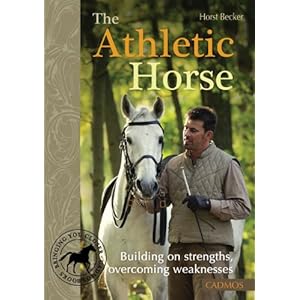
We didn't get home until well after 1 a.m., but I still stayed up and read the first 20 pages or so. Obviously Blue is no dressage horse, but the advice and some of the exercises that Becker recommends are within his ability now. And others we can work towards. Everything is focused on creating that lightness and oneness of purpose that makes riding so fantastic... on the rare occasion that the stars align that way.

And I have to say, Sunday was one of those days when things just felt great. I took Blue to the lake for a little alone time, just the two of us. I wanted to get him out and let him work at his own pace instead of trying to keep up with Bunny or thinking about how he could cut corners to get home.

Was it the weather? The day off? Some unconscious dressage-by-osmosis from the book? I don't know. But Blue and I were rock solid and full of energy. Nothing could spook him—not mountain bikes, dogs or deer leaping up from almost underfoot—not even Dean's horses calling to him as we bombed down the road next to Mill Creek. Blue attacked every hill with equine zeal, and I just focused on staying out of his way.

I wasn't GPS-ing, so I don't know what our actual speed was. And really it doesn't matter anyway. We were moving at a speed that made us both happy and got us home with plenty of daylight to spare.

Light skies, light hands and light hearts. It was a great ride.